Eligible Properties:
- Single Family Residences
- 2-4 Units
- PUDs
- Condos
- Modular Homes
- Rural Homes

Eligible Properties:
A no income verification mortgage is a type of mortgage loan where the lender does not require borrowers to provide proof of income in order to qualify for the loan. This type of mortgage loan is also commonly referred to as a “stated income” or “no doc” loan.
While no income verification mortgages were popular in the early 2000s, they became less common after the subprime mortgage crisis. In fact, many lenders stopped offering these types of loans altogether.
However, there are still some lenders that offer no income verification mortgages, especially for self-employed borrowers or those with non-traditional sources of income.
No income verification mortgages are an option for self-employed or non-traditional income borrowers, but they come with higher rates, fees, limited availability, and potentially higher down payments. Research and compare lenders for the best deal.
Purchase
No income verification mortgages can offer several benefits to borrowers who have difficulty providing traditional income documentation or whose income may fluctuate.
Some of the benefits of no income verification mortgages include:
Because no income verification mortgages do not require borrowers to provide traditional income documentation, the loan approval process can be faster and more streamlined.
Without strict income requirements, borrowers may find it easier to qualify for a loan or obtain a larger loan than they would with a traditional mortgage.
Self-employed borrowers may have difficulty providing traditional income documentation and may benefit from a no income verification mortgage.
Without strict income requirements, borrowers may be able to obtain a larger loan amount than they would with a traditional mortgage.
Borrowers who value their privacy may appreciate the fact that no income verification mortgages do not require the same level of financial disclosure as traditional mortgages.
No income verification mortgages have benefits but come with higher rates, fees, and require a larger down payment. Consider financial situation and research lenders for the best deal.
Requirements for no income verification mortgages can vary depending on the lender and the type of loan.
However, there are some common requirements that borrowers may need to meet to qualify for this type of loan:
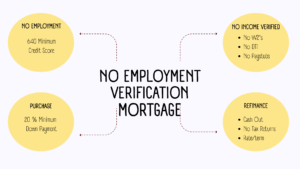
Because lenders are taking on more risk by not verifying the borrower’s income, they may require a higher credit score than they would for a traditional mortgage. Borrowers with a credit score of at least 680 may have an easier time qualifying for a no income verification mortgage.
Some lenders may require a larger down payment to offset the increased risk of the loan. A minimum down payment of 25% may be required to purchase a home for a no income verification mortgage.
While lenders may not require traditional income documentation, they may require proof of assets, such as bank statements, investment accounts, or retirement accounts, to assess the borrower’s ability to repay the loan.
Lenders may require borrowers to have a certain amount of cash reserves, or funds available in case of emergencies, to purchase a home with a no income verification mortgage.
The loan-to-value ratio (LTV) is the amount of the loan compared to the value of the property. Some lenders may require a lower LTV ratio for a no income verification mortgage than they would for a traditional mortgage. A minimum of 80% loan to value is required for a home purchase. A minimum of 75% loan to value is required for a cash out refinance.
When applying for a no income verification mortgage, the requirements can differ depending on the lender and loan type. It’s essential to research and compare loan terms from multiple lenders to find the best deal. Be prepared to provide additional documentation if requested, such as tax returns or business financial statements.
No Income Verification Mortgages
If a borrower is unable or unwilling to pursue a no income verification mortgage, there are several alternative options to consider:
A traditional mortgage may be a better option for borrowers who can provide traditional income documentation, such as pay stubs or tax returns. While traditional mortgages typically have stricter requirements than no income verification mortgages, they may offer more favorable terms and lower interest rates.
A low doc mortgage is similar to a no income verification mortgage, but requires some limited documentation, such as bank statements or business financial statements, to verify the borrower’s income. These types of loans may offer more favorable terms than no income verification mortgages, but may still come with higher interest rates and fees.
An FHA loan is a type of government-backed mortgage that may be a good option for borrowers with lower credit scores or smaller down payments. While FHA loans still require income documentation, they may be more lenient with credit and down payment requirements than traditional mortgages.
If a borrower is unable to qualify for a mortgage on their own, they may consider asking a co-signer to help them secure the loan. A co-signer can provide additional income and credit support to help the borrower qualify for a traditional mortgage.
It’s important for borrowers to carefully consider their financial situation and research multiple options before deciding on a mortgage. Borrowers should also work with a reputable lender or mortgage broker to help guide them through the process and find the best loan for their needs.

Mortgage-World
