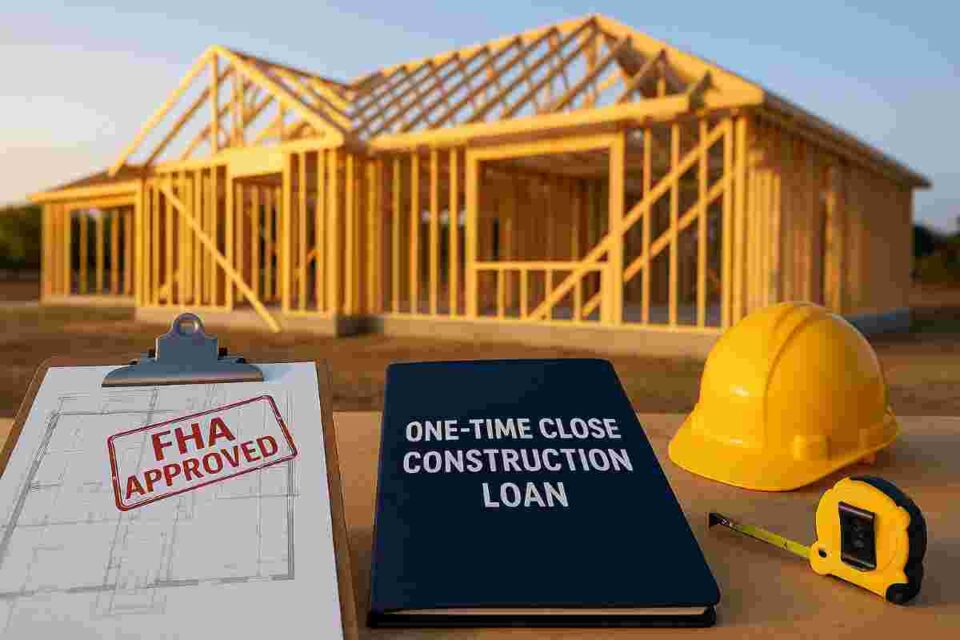
FHA Construction to Permanent loan
FHA Construction to Permanent — One-Time Close Construction Loans
Build your dream home with a single, government-insured mortgage. An FHA Construction to Permanent loan (often called an FHA one-time close loan) combines construction financing and the permanent mortgage into one loan and a single closing — simplifying the process and lowering up-front closing costs for qualified borrowers.
What is an FHA Construction to Permanent Loan?
An FHA Construction to Permanent loan finances the purchase of land (if needed), the construction costs, and converts into an FHA permanent mortgage when construction finishes. Because it’s insured by the Federal Housing Administration (FHA), it typically offers lower down payment requirements and more flexible credit qualifications than conventional construction financing.
Key Benefits
-
Single closing — Only one set of closing costs and one closing instead of separate construction and permanent loan closings.
-
Lower down payment — FHA typically allows as little as 3.5% down for borrowers with qualifying credit (scores typically 580+ for the 3.5% tier).
-
Easier credit qualifying — FHA insurance makes lenders more flexible on credit and debt-to-income ratios compared to many construction lenders.
-
Works for primary residences — Designed for owner-occupied, single-family stick-built homes, modular homes and eligible manufactured homes.
-
Streamlined conversion — The loan automatically converts from the construction phase to the permanent mortgage after final inspections and occupancy.
FHA Construction to Permanent vs. FHA 203(k) — Quick Comparison
-
FHA Construction to Permanent (One-Time Close): Best for building a new home from the ground up or buying lot + building. One loan, single closing.
-
FHA 203(k): Designed for renovation or rehabilitation of existing structures. Good for major remodels or fixer-uppers, not new construction.
Who is Eligible?
-
Primary residence only (1-4 unit restrictions vary by program; one-unit is most common).
-
Borrowers who meet FHA underwriting guidelines (credit score, debt-to-income, employment history).
-
Sufficient down payment (minimum 3.5% for FICO ≥580; higher down payment if credit score is lower).
-
A licensed builder/contractor with approved plans and a signed construction contract.
-
Property and plans must meet FHA construction standards and local building codes.
Typical Requirements (Guidelines)
-
Down payment: Typically 3.5% for eligible borrowers (may be higher if credit <580).
-
Credit score: Many lenders require minimum FICO 580 for 3.5% down; some will accept 500–579 with larger down payment — lender requirements vary.
-
Occupancy: Must be a primary residence.
-
Documentation: Construction contract, budget (hard and soft costs), builder’s qualifications and insurance, architectural plans, and appraisal based on completed value.
-
Reserves: Lenders may require cash reserves and proof of income/stability.
Note: Specific underwriting thresholds (credit score, reserves, allowable property types) can vary by lender. Always verify with your lender for program-specific overlays.
How the Process Works — Step by Step
-
Pre-qualification & lender selection
-
Choose a lender experienced with FHA one-time close loans. Pre-qualify to understand budget and credit needs.
-
-
Select builder and finalize plans
-
Sign a fixed-price construction contract and gather detailed plans, timelines, and budget line items.
-
-
Loan application & documentation
-
Submit income, assets, credit, construction contract, plans, and builder credentials to the lender.
-
-
Underwriting & appraisal
-
Lender underwrites based on the projected (completed) value. FHA requires an appraisal on the future completed value.
-
-
Single closing
-
You close once. Funds for the construction phase are held in escrow and disbursed via draws as work completes.
-
-
Construction draws & inspections
-
Builder requests draws; lender or inspector verifies progress before payments.
-
-
Conversion to permanent mortgage
-
After final inspections and certificate of occupancy, the loan converts to the permanent FHA mortgage — same interest rate structure agreed at closing (confirm whether construction interest is fixed or variable).
-
-
Move-in
-
Occupy the home; begin regular mortgage payments under the permanent loan terms.
-
Costs & Interest
-
Construction draw interest / payments: During construction borrowers often make interest-only payments on funds disbursed (check loan terms).
-
Closing costs: One closing reduces total closing fees vs. two separate loans.
-
Mortgage insurance: FHA loans require upfront mortgage insurance premium (UFMIP) and monthly MIP — factor these into long-term affordability.
Common Pitfalls and How to Avoid Them
-
Choosing an inexperienced lender: Use lenders experienced in FHA one-time-close products.
-
Unclear construction budgets: Require a detailed, fixed-price contract and contingency line item.
-
Builder changes mid-project: Change orders can increase cost and delay conversion — limit mid-build changes or budget contingencies.
-
Missing documentation: Provide complete builder licensing, insurance, and inspection paperwork to avoid draw delays.
FAQ
Q: What is an FHA Construction to Permanent loan?
A: It’s an FHA-insured one-time close loan that finances construction and converts to a permanent mortgage when the home is finished.
Q: How much down payment do I need for an FHA Construction to Permanent loan?
A: Typically 3.5% if your FICO score is 580 or higher. Lower scores may require a larger down payment.
Q: Can I use an FHA Construction to Permanent loan to buy land?
A: Yes — many FHA one-time close loans can finance land purchase plus construction, subject to lender approval.
Q: Is FHA Construction to Perm better than two separate loans?
A: For many borrowers, the single closing reduces cost and simplifies financing. However, program availability and rates vary — compare both options.
Q: How long does construction-to-perm take?
A: Construction timelines depend on the project; lenders will require periodic inspections and a certificate of occupancy before permanent conversion.
Ready to build? Contact our FHA Construction to Permanent loan specialists for a free consultation and pre-qualification.